The village’s persecution of the Blackwoods
We Have Always Lived in the CastleThe village’s persecution of the Blackwoods is not a single confrontation but a continuing pattern that reaches from ordinary encounters in the Village to intrusions at Blackwood house. Its forms change—from coldness in shops and public mockery to the scrutiny of Constance Blackwood after the family poisoning—but the effect is consistent: the Blackwoods are treated as objects of hostility and curiosity rather than neighbors entitled to privacy. Mary Katherine Blackwood’s account shows how this pressure becomes part of daily movement, family memory, and the sisters’ retreat from the outside world.
Class, property, and the Village
The hostility exists alongside a sharply unequal local geography. The Blackwoods own the land between the highway and the river, while the Carringtons own the paper mill; the Clarke family’s house is newer than Blackwood house but, in Mary Katherine’s judgment, no finer. The family’s standing is also marked by its history: their father brought the first piano seen in the Village. Yet inherited property and status do not secure the deference given to other prominent families. Mary Katherine notices that villagers greet the Clarkes when they meet, while the Blackwoods remain objects of hatred.
The public life of the Village makes this disparity visible. The Shepherds of Old Mountain gave it a town hall, and the Clarkes, Carringtons, and Shepherds attend the annual town meeting. There they vote to remove the Harler junk yard from Main Street and the benches outside the general store, only to be outvoted by the villagers each year. The contrast does not establish that the town meeting is a direct campaign against the Blackwoods; instead, it places the family within a local order where property, family name, and public influence do not translate into ordinary goodwill. Blackwood Road circles the family land, and the wire fence built by their father runs along it. For Mary Katherine, the black rock by the entrance to the path through the woods marks the route home and the boundary between public exposure and the protected family property.
Hostility in ordinary encounters
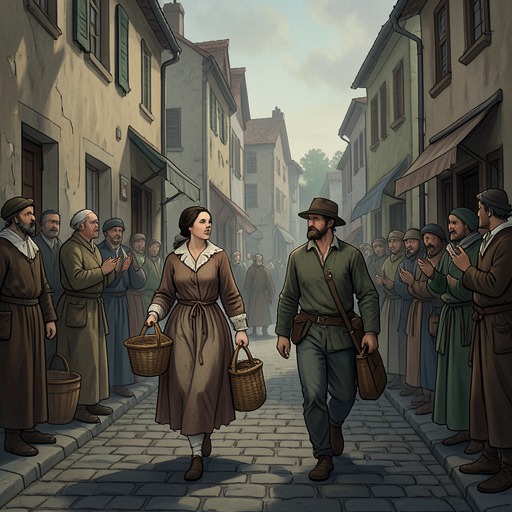
Mary Katherine’s shopping trips turn the Village into a route to be negotiated. She imagines the journey as a board game: the library is the start, the black rock the goal, and each stretch of Main Street carries the chance of a setback. She walks quickly, watches her feet, and avoids looking toward the Rochester house, where her mother was born. Even before she reaches the grocery store, the trip is shaped by surveillance: Miss Dutton watches from behind blinds, and the family has gone without mail and a telephone since the poisoning six years earlier because contact had become unbearable.
At Elbert’s Grocery, the exclusion is enacted through small gestures rather than an open refusal to serve her. Mary Katherine names the food she needs, including a chicken, a small leg of lamb for Julian Blackwood, onions, coffee, bread, flour, walnuts, sugar, milk, cream, butter, eggs, and peanut brittle. The mention of the lamb prompts a gasp around the store; later, a customer remarks on the Blackwoods’ former reputation for setting a fine table, and others giggle. Mr. Elbert assembles the order and calculates its price, but looks past Mary Katherine rather than meeting her gaze. She checks his figures despite knowing he does not make mistakes, one of the few small acts of resistance available to her. The groceries fill two bags, and no one offers to carry them.
The practical consequences extend beyond the shop’s atmosphere. The Harrises have stopped delivering dairy goods to Blackwood house, so Mary Katherine must buy milk and butter herself. She performs the errand while carrying the family’s shopping and absorbing the villagers’ attention. This routine makes the hostility cumulative: ordinary provisions require exposure to people who neither welcome the family nor offer the courtesies that might soften the encounter. Mary Katherine recalls Constance’s advice not to let the villagers see that their behavior matters, but her inward response is hatred and a wish that the imagined suffering of her persecutors would become real. The account presents these thoughts as part of her response to persecution, not as an action carried out during the shopping trip.
Children’s taunts and adult response
The Harris boys’ taunting gives the hostility a public, repeated form. When Mary Katherine passes their yard, they call her name together and line up by the fence. Her account imagines that their parents must have taught them the routine, with Jim Donell and Dunham among the adults she suspects of organizing the children. The episode links the children’s behavior to the larger community without proving that the drills she imagines actually took place. The repeated children’s rhyme about Merricat and poisoned tea also turns the family’s history into a taunt: it recalls the poisoning while making Mary Katherine herself its target.
On another occasion, the Harris boys’ mother comes onto the porch to see what they are shouting. Mary Katherine asks her to make them stop, but the woman tells the children not to call the woman names and not to approach the fence. The boys answer their mother; she then remains on the porch and laughs as Mary Katherine walks away and the children continue shouting. The exchange offers a limited appearance of adult intervention, but it does not end the harassment. The fence matters here twice over: it marks the Blackwood property boundary, and the children gather beside it to direct their abuse at someone who is passing outside it.
Constance and the spectacle of the poisoning
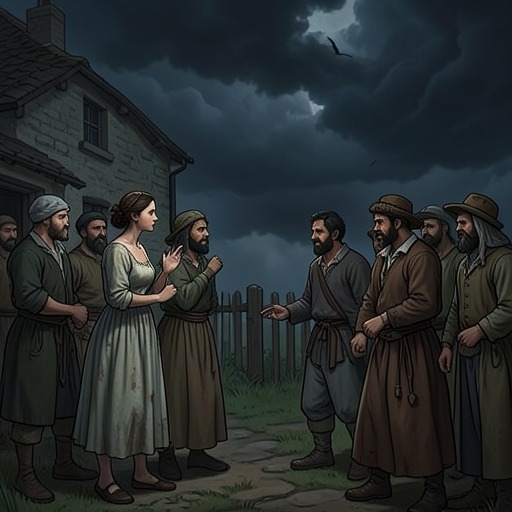
After the poisoning, the villagers’ hostility takes the form of persistent attention to Constance Blackwood. Mary Katherine remembers visitors waiting to see her, identifying her to one another as the woman accused of murder, watching her face for signs of crying, and hoping to take her picture. Some treat the grounds as a source of keepsakes, proposing to take flowers or a stone from the garden. Their curiosity is not limited to conversation at the gate: visitors arrive at the house, call for Constance, and claim an entitlement to see her because she killed the family members.
The intrusions described in Mary Katherine’s recollection range from repeated knocking and calling to attempts to reach other entrances and peer through windows. Visitors park by the steps, hold picnics on the lawn, photograph one another in front of the house, let dogs into the garden, and write their names on the walls and front door. Some leave when no one answers; others persist around the house. The house’s locked windows and doors therefore answer a recognizable history of unwanted access. Mary Katherine remembers that even a slight movement behind the dining-room curtains could make visitors rush toward the house, calling out that they had seen someone. At the time of the later visit in the scene, the windows and side door are locked, and she stays inside rather than reveal herself.
The persecution also shaped Mary Katherine’s place in the public story of the case. She remembers being excluded from the courtroom and sent to an orphanage cot while people watched Constance there. The visitors sought Constance and sometimes Julian Blackwood; they did not ask for Mary Katherine or take her picture. This difference does not spare her the community’s hostility, but it gives that hostility an uneven distribution: Constance becomes its most visible object, while Mary Katherine remembers her own separation and waits for Constance to return.
Isolation and narrative significance
The pattern joins public humiliation to the Blackwoods’ increasing separation from ordinary village life. No mail, no telephone, discontinued dairy delivery, watched errands, and a guarded route home are distinct consequences and conditions, not interchangeable signs of mere dislike. The family’s fence and the locked house offer physical limits against intrusion, while Mary Katherine’s careful movement through the Village reveals how little those boundaries can shield her during an errand or on the road.
Because the episodes are recounted through Mary Katherine’s first-person perspective, the account distinguishes what she witnesses from what she suspects or imagines. The children’s synchronized calls and the mother’s response are witnessed events; the notion that adults trained the children is Mary Katherine’s conjecture. Her fantasies of the villagers’ deaths likewise disclose the intensity of her resentment without turning them into actual events. This perspective makes the persecution both social and intimate: the reader sees concrete acts of mockery and invasion, but also the defensive imagination through which Mary Katherine moves past them. Repeated attention to names, fences, doors, and routes gives the hostility a structure. The Village keeps calling toward the Blackwood family; Mary Katherine keeps moving toward the black rock, the locked boundary, and home.